In a warming world, droughts can become more frequent even if precipitation does not change, because higher temperatures raise the amount of water the atmosphere draws from soil and plants: the evaporative demand. In our new paper in Physics and Chemistry of the Earth, we measured how large this effect is in Türkiye.
How we did it
We used data from 189 MGM stations for 1965–2025 and computed the frequency of drought months with two indices:
- SPI: based on precipitation only.
- SPEI: also accounts for potential evapotranspiration (PET), i.e. evaporative demand.
We compared the two at 1-, 3- and 12-month timescales with 1965–1994 as the reference period, tested trends with a variance-corrected Mann-Kendall test, and expressed results as shares of the national area using Thiessen polygons. To isolate the effect of temperature, we also computed a counterfactual SPEI in which PET is fixed at its reference climatology.
What we found
- Temperature rose over 98% of the country, with a change year of 1998 at most stations.
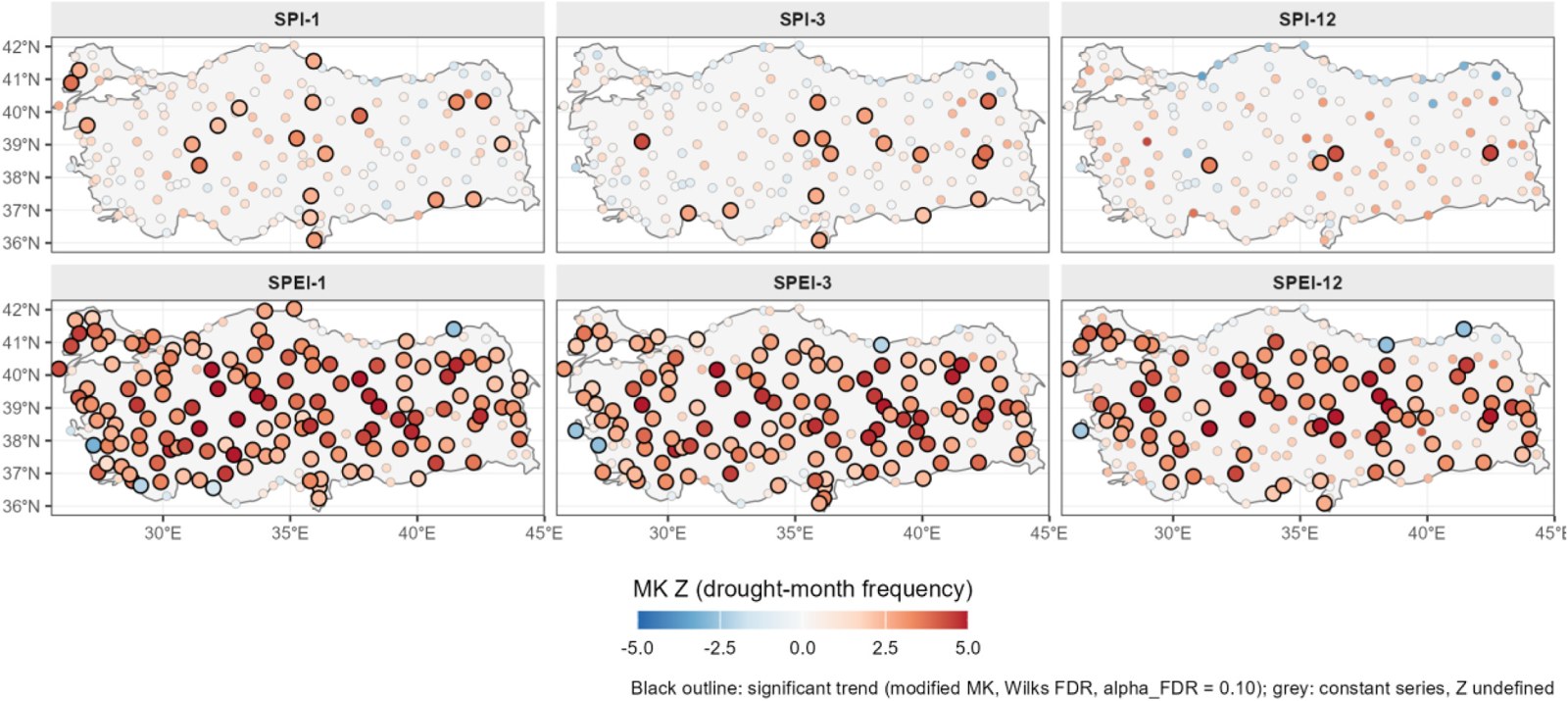
- Precipitation-based drought barely increased; drought that counts evaporation increased widely: SPI drought frequency rose over only 3–13% of the area, SPEI drought frequency over 53–80%.
- The difference points the same way everywhere: the drought driver index (ΔZ), which measures the gap between the two, was positive over 92–93% of the area and in every region, season and timescale.
- The contribution of evaporative demand grew: in the counterfactual analysis, the PET contribution increased significantly over 67–75% of the area. The same precipitation yields more drought months under higher PET.
- The result does not depend on the PET method: the sign of ΔZ was the same with Hargreaves and Thornthwaite PET, though its magnitude and the regional ranking depended on the method.
Why the reference period matters
Drought indices are computed against a reference period. Moving the reference period from 1965–1994 to 1996–2025 reduced SPEI-12 drought frequency in 2011–2025 from 40.6% to 23.1%. Using a recent reference period can partly hide the effect of warming, so drought monitoring systems need to choose their reference period deliberately.
Why it matters
Türkiye is part of the rapidly warming Eastern Mediterranean. Our results show that the increase in drought frequency since the late 1990s is consistent with a dominant contribution from warming-driven evaporative demand rather than precipitation deficits. Drought monitoring based on precipitation alone can miss much of this increase.
The paper
Eşit M, Yaşa İ, Yüce Mİ, Değer İH (2027). Temperature-driven amplification of drought under shifting hydroclimatic regimes across Türkiye. Physics and Chemistry of the Earth, 145: 105032. doi:10.1016/j.pce.2026.105032