At COP31 (Antalya, 9–20 November 2026), we presented findings from our Yeşilırmak project, funded by Adıyaman University BAP (MÜFMAP/2026-0001), as a digital poster at the pavilion of Türkiye’s Council of Higher Education (YÖK).
Poster: Determination of Temporal and Spatial Trends in Low Flows in the Yeşilırmak Basin: The Effect of Short- and Long-Term Persistence
Authors: Musa Eşit, İslam Yaşa, Mehmet İshak Yüce, İbrahim Halil Deger
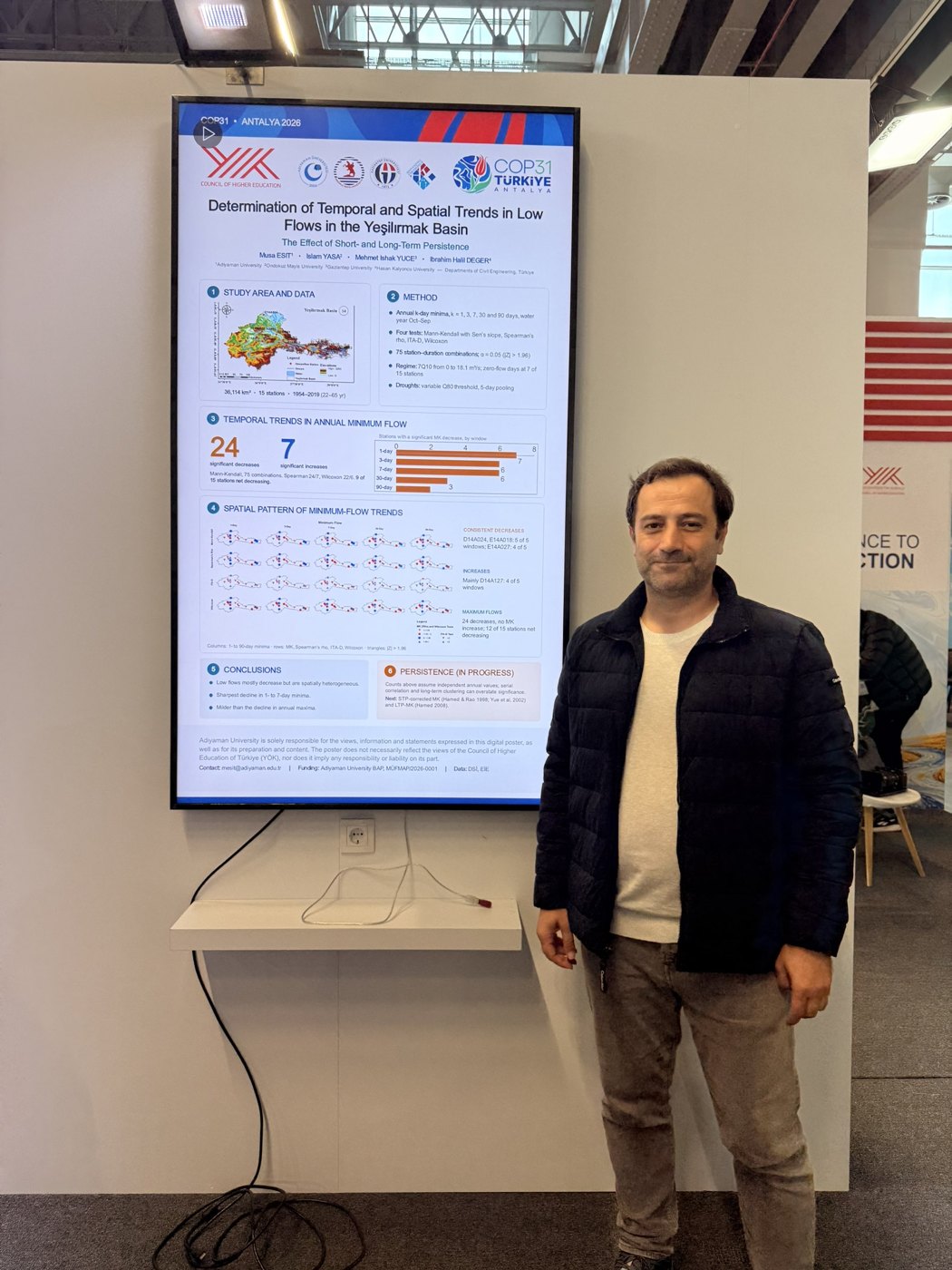
What the poster showed
We analyzed 1-, 3-, 7-, 30- and 90-day annual minimum flows at 15 gauging stations (1954–2019) in the 36,114 km² Yeşilırmak Basin, testing trends with Mann-Kendall (with Sen’s slope), Spearman’s rho, ITA and Wilcoxon. Data came from DSİ and EİE.
- Low flows are mostly decreasing: across 75 station–duration combinations, Mann-Kendall found 24 significant decreases and 7 significant increases; 9 of 15 stations show a net decrease.
- Sharpest decline at short durations: the decrease is strongest in the 1- to 7-day minima.
- Spatially heterogeneous: some stations decrease consistently across most windows, while others show increases.
- High flows declined more: annual maximum flows showed 24 decreases and no Mann-Kendall increase, with 12 of 15 stations net decreasing. The decline in low flows is milder.
What’s next
These counts assume independent annual values. Serial correlation and long-term persistence can overstate significance, so next we will apply Mann-Kendall tests corrected for these effects.
For more on the project, see our Projects page.