The timing of when plants green up, reach peak greenness and senesce each year, known as phenology, is one of the most sensitive indicators of how ecosystems respond to climate. In our new paper in Ecosystems, we mapped this calendar across Türkiye’s diverse climates and measured how closely it depends on temperature and water.
How we did it
We used 23 years (2001–2023) of MODIS NDVI satellite data and ERA5-Land reanalysis. For each pixel we estimated the start and end of the growing season, and we summarized the results across Türkiye’s seven geographic regions.
Three vegetation calendars
Three coherent phenological regimes emerged:
- Spring-peak regime: 65.5% of the vegetated area, dominant across the semi-arid interior.
- Summer-peak regime: 25.7%, in the eastern highlands and the Black Sea uplands.
- Winter-peak regime: 8.5%, along the Mediterranean and Aegean coasts.
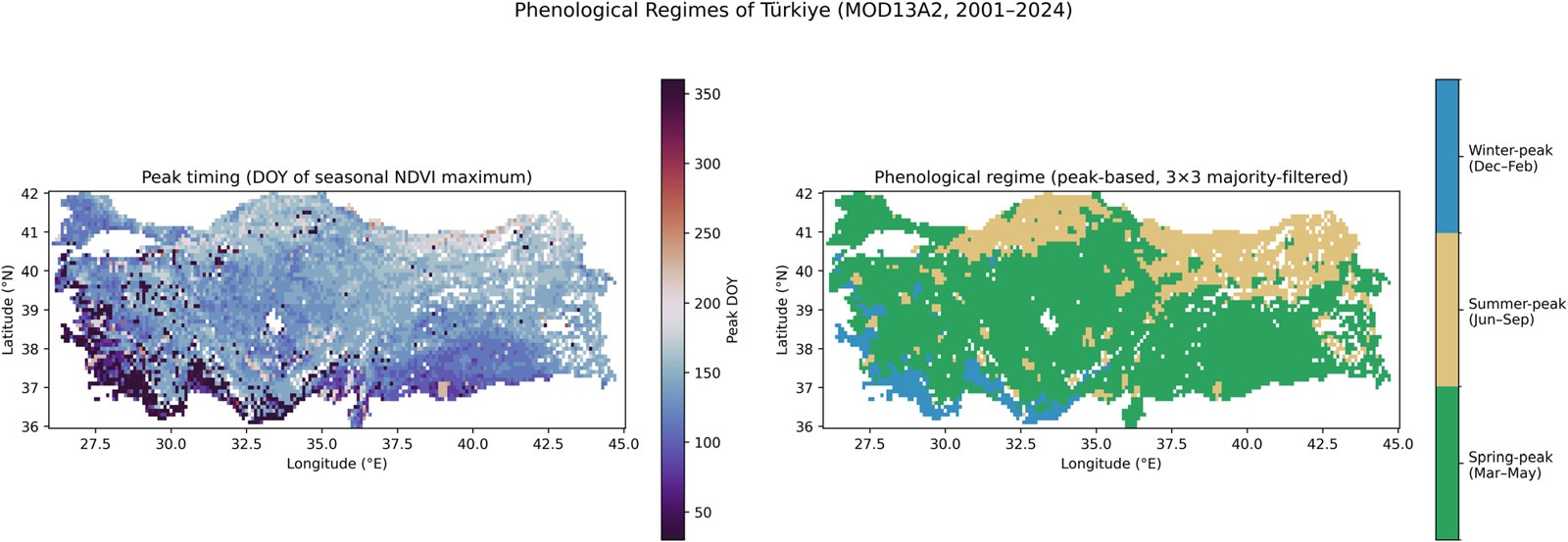
Nationally, the median growing season begins on day 101 (around 11 April) and ends on day 187 (around 6 July).
Is the growing season getting longer?
Many studies report a lengthening growing season in temperate and boreal regions. Across Türkiye, however, we found no significant trend. The only suggestive signals, pointing to an earlier start, were in Eastern and Southeast Anatolia.
Where vegetation is most sensitive to climate
The link between vegetation and climate varies strongly across the country:
- Highland regions are tightly governed by temperature and water. Eastern Anatolia shows the strongest link: the end of the growing season is closely tied to summer water availability (r = 0.85) and heat (r = −0.78).
- In the semi-arid lowlands, green-up is only weakly linked to moisture, most strongly at 6–12-month drought timescales, which points to the role of the previous winter’s water recharge.
- In Eastern Anatolia, the Black Sea and Central Anatolia, grassland depends more on summer water than cropland does.
Why it matters
The results show that Türkiye’s highland ecosystems are already closely tied to summer water and heat stress, which leaves them the most vulnerable to projected warming. Rangeland management, agricultural planning and climate adaptation policy need region-specific approaches.
The paper
Eşit M, Yılmaz Y, Kalkan N (2026). Phenological regimes of Türkiye and the spatial structure of their climate sensitivity. Ecosystems, 29: 97. doi:10.1007/s10021-026-01122-7